



Contents of the article
- Which Hryvnia Banknotes Are in Circulation
- Which Coins Are in Circulation in Ukraine
- Which Hryvnia Circulation Coins Are Used Today
- How Receipt Rounding Works
- What Are Circulating Commemorative Coins and Why You May See Them in Payments
- Which Hryvnia Denominations Are in Circulation in Ukraine in 2026
- Features of the Formation of the Modern Currency Lineup
- The 2000 Hryvnia Banknote: Why Ukraine Introduced a New Denomination
- Why Ukraine Has These Specific Denominations: The 1–2–5 Principle
- Which Hryvnia Banknotes Are Largest and Smallest in Size
- Why Old and New Banknotes of the Same Denomination Can Be Valid Simultaneously
- Summary of Major Changes in the Ukrainian Currency Lineup
- Conclusion
The composition of cash hryvnia in Ukraine is changing gradually: some banknotes are replaced by newer ones, part of the banknotes from previous issues continues to circulate freely alongside modern ones, and small denominations have fully transitioned into coins. In addition, starting September 4, 2026, Ukraine's banknote lineup was supplemented with a new highest denomination — 2000 hryvnias.
To make payments in stores, bank cash desks, and business entities convenient and clear, it is important to know the current status of each coin and bill. In this article, we detail what the banknote and coin lineup of Ukraine looks like as of September 2026, which money acts as valid legal tender, and which has already lost its validity and is subject to exchange.
Which Hryvnia Banknotes Are in Circulation
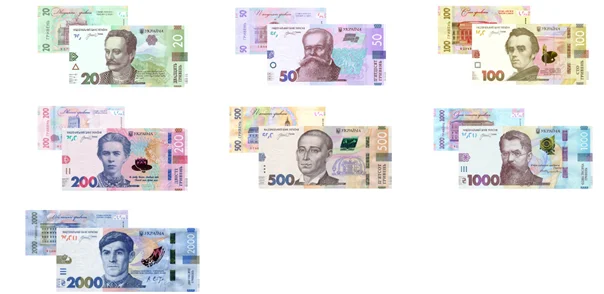
Currently, there are 7 banknote denominations in circulation — 20, 50, 100, 200, 500, 1000, and 2000 hryvnias.
Banknotes of the same denomination may differ in appearance. The National Bank of Ukraine periodically updates their design and security features. The consecutive stages of such updates are called generations. Overall, four generations of banknotes have been issued throughout the history of the hryvnia.
Four Generations of Banknotes: Current Status
- Generations I and II (issued before 2003): Completely withdrawn from circulation on October 1, 2020. They are no longer legal tender.
- Generation III (2003–2007 issues):
1, 2, 5, and 10 hryvnias — withdrawn from circulation on March 2, 2026 (replaced by corresponding coins). They can no longer be used for payments, but can be exchanged for free at banks.
20, 50, 100, 200, and 500 hryvnias — remain legal tender. They are gradually being withdrawn by banks upon entering cash desks, but do not need to be specially exchanged.
- Generation IV (2014–2019 issues): Modern banknotes that form the core of the country's cash circulation.
As we can see, banknotes of several generations can be in circulation simultaneously. At the same time, they share the same face value and are legal tender.
New Hryvnia Banknotes: Modified Fourth-Generation Banknotes
Since 2024, the NBU has been introducing scheduled modifications of Generation IV banknotes with additional security elements. The reverse side features the slogan "GLORY TO UKRAINE! GLORY TO THE HEROES!".
Modification does not mean a complete replacement of the previous banknote: it is an updated version of an existing design. All other main design and security features in the modified banknotes correspond to the respective modern designs.
Modified banknotes do not replace denominations instantly; they enter circulation in parallel with previous issues of the same generation.
Key Points for Payments
- 20, 50, 100, 200, and 500 UAH Generation III banknotes: Valid legal tender that can be freely used for payments, but they are being gradually withdrawn from circulation.
- 1, 2, 5, and 10 UAH Generation III banknotes: Not accepted for payments, replaced by corresponding circulation coins. Such banknotes can still be exchanged according to rules established by the NBU.
- Presence of the slogan "GLORY TO UKRAINE!": This is a mark of the newest issues, not a condition of money validity. Generation IV banknotes with and without the slogan are equally valid.
Current series of banknotes
Which Coins Are in Circulation in Ukraine
Ukraine's coin lineup has undergone significant changes in recent years. The main goal of these updates is to remove small coins from use and replace worn-out small-denomination paper bills with more durable coins.
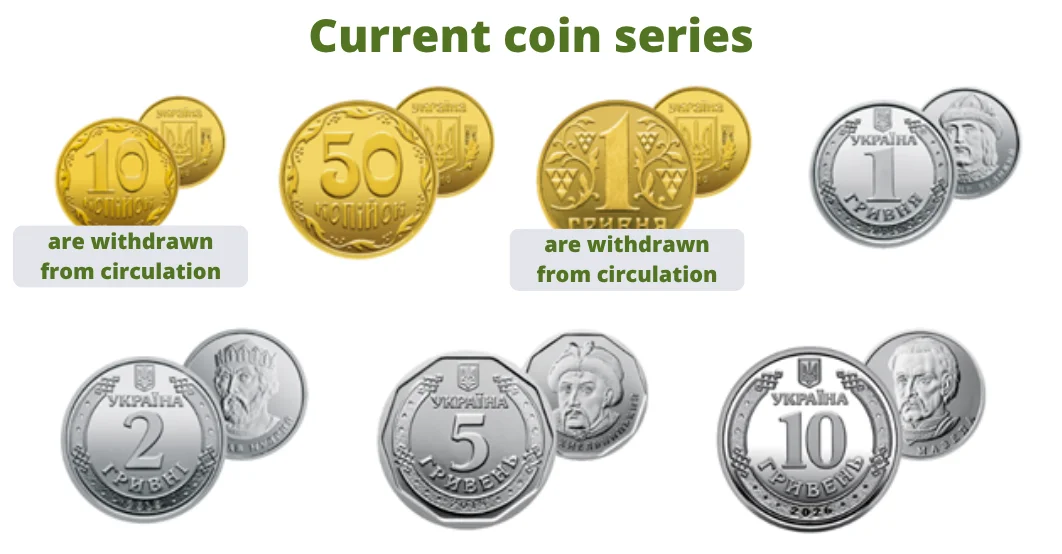
Today, Ukraine's coin lineup consists of two groups: change coins in kopiykas and circulation coins in hryvnias. In everyday transactions, you can encounter the following denominations:
- 10 kopiykas and 50 kopiykas;
- 1, 2, 5, and 10 hryvnias.
Kopiykas: Which Coins Remain Valid
- The 50 kopiykas coin continues to fully remain in circulation.
- The 10 kopiykas coin has a different status. On October 1, 2025, the NBU stopped minting it and began its gradual withdrawal from cash circulation. However, 10 kopiykas remain legal tender: they can be used to pay for goods and services. Banks and the NBU do not issue coins of this denomination from cash desks, but accept them for incoming operations.
- Coins in denominations of 1, 2, 5, and 25 kopiykas have been withdrawn and are no longer used for payments. 1, 2, and 5 kopiykas were withdrawn on October 1, 2019; 25 kopiykas — on October 1, 2020.
Which Hryvnia Circulation Coins Are Used Today
The modern lineup of circulation coins includes four denominations: 1, 2, 5, and 10 hryvnias. They gradually replaced banknotes of corresponding denominations and today are the primary means of payment. All modern coins of these denominations have a silver color and a compact size.
During calculations, you might still encounter an old gold-colored 1-hryvnia coin (issued before 2018). Since October 1, 2020, the NBU has been gradually withdrawing such coins from circulation as they reach banks. However, this coin remains legal tender: it is not invalid, and you can freely pay with it in stores.
How Receipt Rounding Works
Since small kopiykas are no longer used, cash settlement rules developed by the NBU apply to round the total sum on receipts (to 0 or 50 kopiykas):
- 1 to 24 kopiykas — rounded down to 00 kop.
- 25 to 49 kopiykas — rounded up to 50 kop.
- 51 to 74 kopiykas — rounded down to 50 kop.
- 75 to 99 kopiykas — rounded up to 1 hryvnia.
Rounding rules apply exclusively to cash payments. If you pay by bank card or online, rounding does not occur — the exact amount on the receipt down to the kopiyka is debited from your account.
What Are Circulating Commemorative Coins and Why You May See Them in Payments
In addition to standard circulation coins, the NBU issues circulating commemorative coins. They have a special design dedicated to a specific event, region, state institution, military unit, or another topic, while remaining fully valid legal tender.
Most such issues encountered in everyday circulation have a face value of 10 hryvnias. Among the topics of recent years are units of the Defense and Security Forces of Ukraine, regions of Ukraine, the National Police, the State Emergency Service of Ukraine, and others. In 2026, the NBU notably issued circulating commemorative coins titled "We Are Strong. We Are Together", dedicated to Kherson, Zaporizhzhia, and Kharkiv regions.
For a regular user, the principle is simple: if such a coin is an NBU circulating commemorative coin with a face value of 10 hryvnias, it holds the same face value as a regular 10-hryvnia coin during transactions. That is, an unusual design does not turn it into a souvenir that cannot be spent in a store.
Which Hryvnia Denominations Are in Circulation in Ukraine in 2026
As of September 2026, the cash lineup of the hryvnia includes change coins in denominations of 10 and 50 kopiykas, circulation coins in denominations of 1, 2, 5, and 10 hryvnias, and banknotes ranging from 20 to 2000 hryvnias.
At the same time, identical numbers on currency items do not always mean identical appearances. Banknotes of the same denomination may belong to different generations: newer ones are already replacing older ones, but older designs still remain legal tender.
Therefore, to get a complete picture, it is important to distinguish between denomination and banknote issue/design.
Complete List of Valid Hryvnia Denominations
| Denomination | Form | Issue / Description | Current Status in Circulation |
| 10 kopiykas | Coin | Pre-2025 designs | In circulation (gradually withdrawn) |
| 50 kopiykas | Coin | Standard issues | Fully in circulation |
| 1 UAH | Coin | Silver (since 2018) | Fully in circulation |
| 1 UAH | Coin | Gold-colored (pre-2018) | In circulation (gradually withdrawn) |
| 2 UAH | Coin | Silver (since 2018) | Fully in circulation |
| 5 UAH | Coin | Silver (since 2019) | Fully in circulation |
| 10 UAH | Coin | Silver (since 2020) & commemorative | Fully in circulation |
| 20 UAH | Banknote | Gen IV (2018) / Gen III (2003) | Both designs valid (old gradually withdrawn) |
| 50 UAH | Banknote | Gen IV (2019) / Gen III (2004) | Both designs valid (old gradually withdrawn) |
| 100 UAH | Banknote | Gen IV (2014) / Gen III (2005) | Both designs valid (old gradually withdrawn) |
| 200 UAH | Banknote | Gen IV (2019) / Gen III (2007) | Both designs valid (old gradually withdrawn) |
| 500 UAH | Banknote | Gen IV (2015) / Gen III (2006) | Both designs valid (old gradually withdrawn) |
| 1000 UAH | Banknote | Gen IV (2019) | Fully in circulation |
| 2000 UAH | Banknote | Gen IV (2026) | Fully in circulation since Sept 4, 2026 |
Features of the Formation of the Modern Currency Lineup
Why 1, 2, 5, and 10 Hryvnia Banknotes Were Replaced by Coins
The transition from banknotes to coins for small denominations was not immediate, but gradual.
Coins denominated in 1 and 2 hryvnias appeared in circulation back in 2018, 5 hryvnias in 2019, and 10 hryvnias in 2020. For a certain period, they circulated alongside banknotes of corresponding denominations. 1, 2, 5, and 10 hryvnia banknotes of the 2003–2007 issues officially ceased to be legal tender on March 2, 2026.
The reason for this transition is practical. The NBU notes that the average lifespan of small-denomination banknotes is about 2.5 years, whereas coins can remain in circulation for about 20–25 years. Therefore, for denominations actively used in daily transactions, the coin format makes it possible to keep currency items usable for longer. The transition also reduces costs related to processing, transporting, storing, and circulating such banknotes.
That is why today 1, 2, 5, and 10 hryvnias are represented by coins, and the banknote lineup starts at 20 hryvnias.
This does not mean that small-denomination banknotes "disappeared" overnight. They were gradually replaced by coins over several years, and the final withdrawal of old banknotes occurred only after coins of the corresponding denominations had already been in regular cash circulation for a long time.
The 2000 Hryvnia Banknote: Why Ukraine Introduced a New Denomination
Starting September 4, 2026, the National Bank of Ukraine introduced a new banknote denomination of 2000 hryvnias into cash circulation — the highest denomination of the Ukrainian hryvnia. The obverse side of the banknote features a portrait of Vasyl Stus, while the reverse side features the building of the Faculty of Philology at Donetsk National University, where the poet studied.
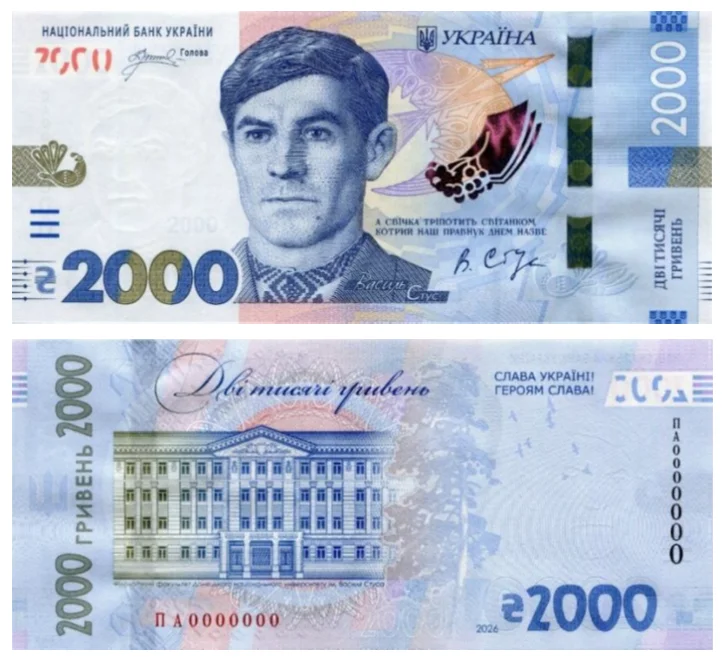
The decision to expand the banknote lineup stems from changes in the Ukrainian economy and cash circulation structure following the introduction of the 1000 hryvnia banknote in 2019.
According to NBU data, total cash in circulation grew from nearly 390 billion hryvnias in 2019 to over 970 billion hryvnias as of July 1, 2026. In terms of value, 1000 hryvnia banknotes accounted for over 55% of all cash in circulation.
Dynamics of Cash in Circulation
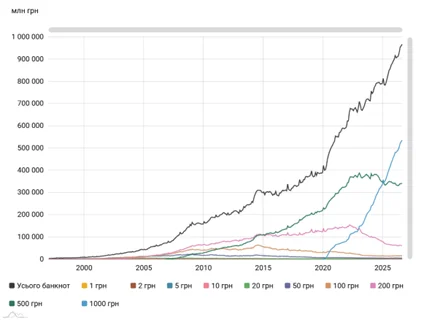
The new denomination holds practical value for organizing cash circulation: storing, transporting, and processing the same sum requires fewer 2000-hryvnia banknotes than 1000-hryvnia banknotes. This allows for optimization of cash operations.
Why Ukraine Has These Specific Denominations: The 1–2–5 Principle
If we arrange the main hryvnia denominations sequentially, we get:
1 → 2 → 5 → 10 → 20 → 50 → 100 → 200 → 500 → 1000 → 2000 hryvnias.
In this sequence, the 1–2–5 principle is clearly visible: at each next order of magnitude, denominations 1, 2, and 5 are used, multiplied by 10.
This is not a random arrangement of numbers. Such an approach allows for the formation of a compact set of denominations that can assemble a wide range of amounts without creating an excessively large number of different currency items.
For example, an amount of 88 hryvnias can be formed using:
50 + 20 + 10 + 5 + 2 + 1 = 88 hryvnias.
That is why in monetary systems, it is not merely the quantity of denominations that matters, but the ratio between them. Too many close denominations would complicate the system, while excessively wide gaps between denominations would increase the number of currency items needed for transactions.
In modern hryvnia, this principle is clearly evident in the transition from coins to banknotes. Denominations 1, 2, 5, and 10 hryvnias are represented by coins, followed by banknotes of 20, 50, 100, 200, 500, 1000, and 2000 hryvnias.
Therefore, the appearance of the 2000 hryvnia banknote does not disrupt the established lineup, but continues it: after 1000 hryvnias, the next denomination following the same logic is 2000 hryvnias.
Which Hryvnia Banknotes Are Largest and Smallest in Size
Denomination is not the only difference between banknotes. The modern banknote series also features a consistent system of sizes.
Banknotes denominated in 20, 50, and 100 hryvnias measure 69 × 130 mm, 72 × 136 mm, and 75 × 142 mm, respectively. Beyond that, the width remains fixed at 75 mm, while the length increases: 200 hryvnias — 148 mm, 500 hryvnias — 154 mm, 1000 hryvnias — 160 mm.
Thus, as denomination grows, the banknotes gradually become larger. This difference helps distinguish them not only visually, but also by touch.
Banknotes also feature special tactile relief elements for visually impaired individuals. These make it possible to determine the denomination by touch. This is one example of how modern money design accounts for practical user needs alongside aesthetic ones.
Color design also aids in quickly distinguishing denominations. At the same time, color or appearance alone is not enough to verify authenticity. To learn more about how to check Ukrainian banknotes for authenticity and what to pay attention to during payments, read our dedicated article "What is counterfeit money and how to detect it".
Why Old and New Banknotes of the Same Denomination Can Be Valid Simultaneously
Gradual replacement of banknotes is standard practice in cash circulation. When the NBU introduces a more modern design, it does not automatically invalidate the previous one.
For example, 50-hryvnia banknotes of the 2004 issue and 2019 issue have been in circulation in parallel for a long time. New banknotes enter cash circulation, while old ones are gradually withdrawn as they wear out. An identical process applies to 20, 100, 200, and 500 hryvnias.
Therefore, a difference in design is not in itself a sign of invalidity. For instance, an older 200-hryvnia banknote of the 2007 issue remains legal tender, even though the NBU no longer supplies it to cash circulation and is gradually replacing it with 2019 issue banknotes.
This approach allows the currency lineup to be updated without forcing all citizens to exchange the money in their wallets all at once. New banknotes enter transactions gradually, while unusable and older banknotes are withdrawn naturally.
Summary of Major Changes in the Ukrainian Currency Lineup
Looking at the coins and banknotes valid today together, the changes of recent years follow several clear directions:
- Low denominations have transitioned primarily into coin form. 1, 2, 5, and 10 hryvnias are represented by circulation coins, and the corresponding banknotes of 2003–2007 issues ceased to be legal tender on March 2, 2026.
- Modern banknotes have gradually replaced older issues without instantaneous withdrawal of all predecessors. Therefore, today your wallet can legally hold, for example, a modern 500-hryvnia banknote with the slogan and an older 500-hryvnia banknote without it. Both can be legal tender if the older bill belongs to a valid issue.
- The denomination scale has expanded upward. Following 1000 hryvnias, a 2000 hryvnia denomination was introduced on September 4, 2026. Its introduction relates to shifts in cash structure and an increase in overall cash volumes in the economy.
- The denomination structure remains consistent: 1, 2, and 5 repeat across different levels — 1, 2, 5, 10, 20, 50, 100, 200, 500, 1000, 2000 hryvnias.
As a result, the modern lineup combines several functions: coins ensure small-amount transactions with a longer lifespan, banknotes serve higher denominations, and gradual updates replace worn currency without requiring immediate full-scale exchanges by the public.
Conclusion
The modern banknote and coin lineup of the hryvnia is not a random set of denominations and physical forms.
Small denominations of 1, 2, 5, and 10 hryvnias are represented primarily by coins, which have a significantly longer service life. The banknote lineup begins at 20 hryvnias and sequentially reaches 1000 hryvnias, and from September 2026 — 2000 hryvnias. Meanwhile, older banknotes of 20, 50, 100, 200, and 500 hryvnias can still circulate alongside modern designs.
Denominations are built on the clear 1–2–5 principle, and banknote updates occur gradually as worn-out bills are replaced. Thus, the modern hryvnia functions as a structured system where every denomination and currency form fulfills its practical function.
As of September 4, 2026, Ukraine's active circulation includes coins in denominations of 10 and 50 kopiykas, 1, 2, 5, and 10 hryvnias, as well as banknotes in denominations of 20, 50, 100, 200, 500, 1000, and 2000 hryvnias. Certain older designs and circulating commemorative coins also remain part of real cash circulation according to their status established by the NBU.