




Contents of the article
- The Fight for Sovereignty and the Soviet Period (20th Century)
- Restoration of Independence: From Coupons to the Hryvnia (1991–1996)
- Shah or Kopiyka: Choosing the Coin's Name
- The Hryvnia in the 21st Century: Trials, Protection, and the Digital Era
A nation's own monetary system is not merely a means of payment, but one of the most vital attributes of state sovereignty. When Ukraine fought for its independence during the revolutionary events of the early 20th century and restored it in the late 1990s, creating its own currency was always proof that the country was taking responsibility for its own economy and future. This is the story of how, through liberation struggles, Soviet occupation, wartime underground resistance, 1990s hyperinflation, and the digital revolution, Ukrainians forged their path to the modern, resilient hryvnia.
The Fight for Sovereignty and the Soviet Period (20th Century)
The First Currency of the Liberation Struggle: The Rebirth of the Hryvnia and the Trident
The first attempt to issue national currency in the 20th century was made by the Ukrainian People's Republic at the end of 1917 — a 100-karbovanets banknote designed by the prominent graphic artist Heorhiy Narbut. It was on this banknote that the Trident of Volodymyr the Great first appeared — even before it was officially adopted as Ukraine's coat of arms. Due to haste, the banknotes were printed on ordinary yellowish paper without security features, leading the public to quickly nickname them "fried eggs" (yaeshni). By the spring of 1918, the government introduced a new currency — the hryvnia — and due to a shortage of metal, temporary paper money-stamps (shahy) were issued in place of metallic coins.
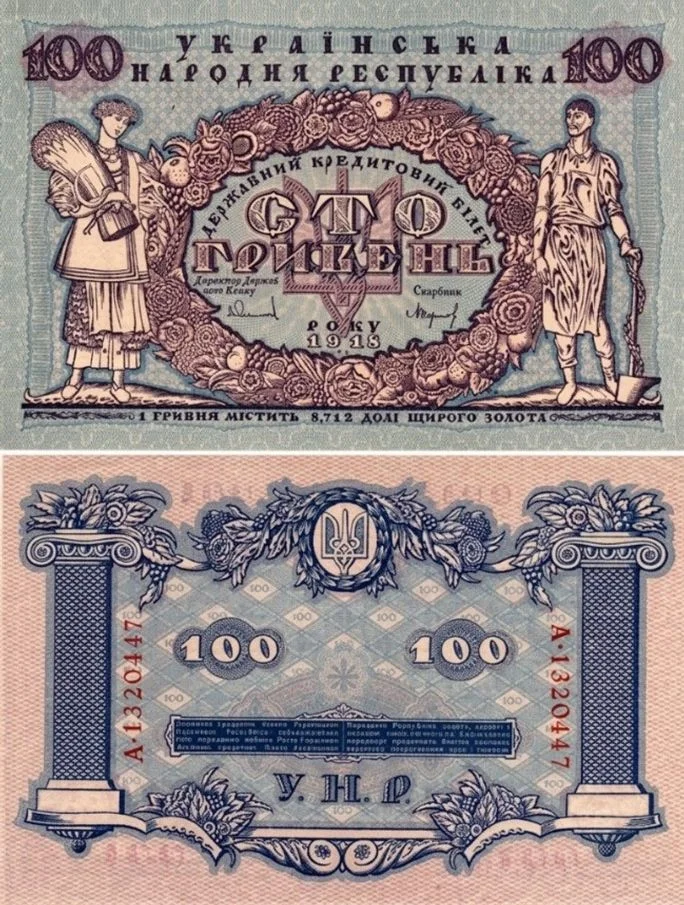
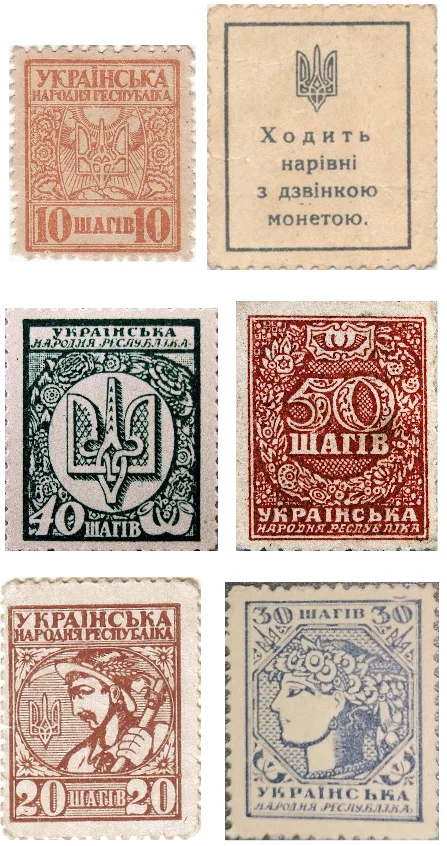
Upon coming to power in April 1918, Hetman Pavlo Skoropadsky restored the karbovanets as the primary monetary unit, but did not cancel the issuance of hryvnias. Their printing was ordered in Berlin: a German printing house produced exquisite banknotes featuring intricate watermarks and sophisticated designs, which matched the leading currencies of Europe in both security level and printing quality.
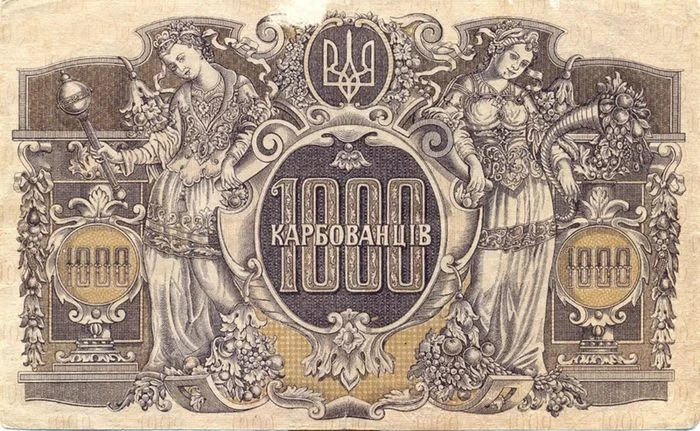
During the turbulent years of 1919–1920 under the Directorate of Symon Petliura, constant shifts in the front line forced the government to continuously evacuate its printing presses between Kamianets-Podilskyi, Lutsk, and Warsaw. An acute shortage of cash gave rise to a unique phenomenon: over 300 Ukrainian cities and towns, from Odesa to Zhytomyr, began issuing their own local money and payment vouchers to meet the daily needs of the population.
Soviet Standardization
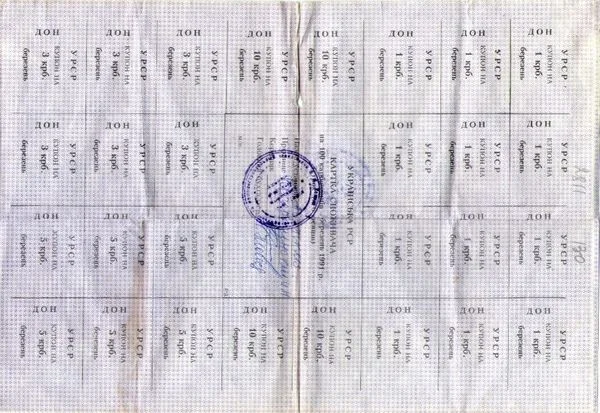
With the final occupation of Ukraine by the Bolsheviks, the national monetary system was lost for nearly 70 years. Ukrainians used the Soviet ruble (which was officially translated into Ukrainian as karbovanets). The first Soviet rubles — dubbed "Bolshevik thousands" by the populace — introduced by the Council of People's Commissars in Soviet Ukraine had a miserable exchange rate, mirroring the Soviet system itself. This led to several monetary reforms, but none achieved meaningful success. The system had peculiar features, such as 3-karbovanets banknotes, which were unusual for European currencies. However, the republic enjoyed no financial autonomy whatsoever, as all issuance decisions were made centrally in Moscow. Despite this, the currency's weakness and perpetual shortages spurred the parallel use of cut-off coupons.
Bofons: The Money of the Ukrainian Underground
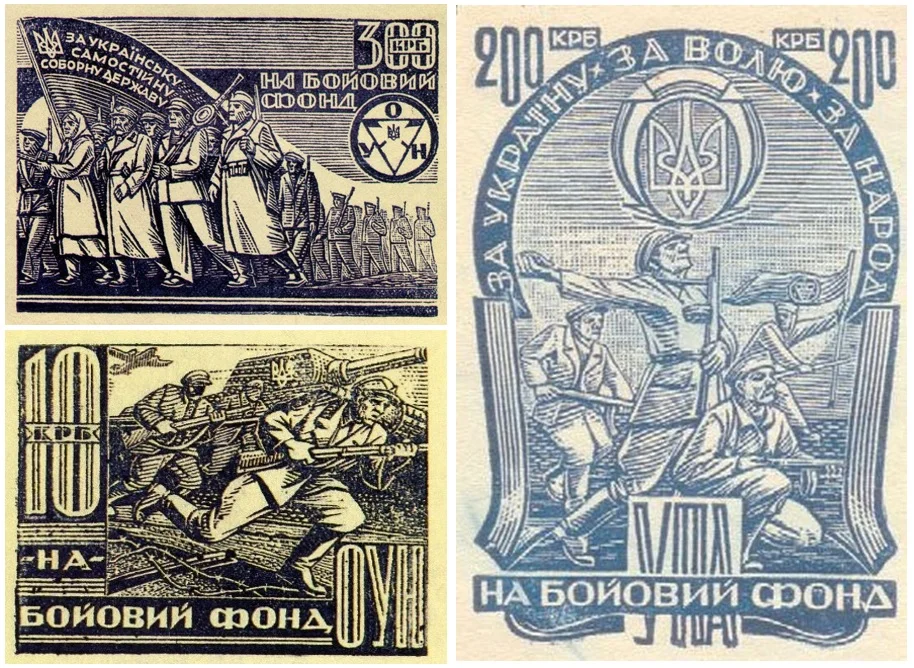
Throughout the long struggle for independence, money served not only as a medium of exchange but also as a tool to sustain resistance. In the 1930s–1950s, fighters of the OUN and UPA used bofons (short for boiovyi fond or "combat fund") — single- or double-sided underground monetary certificates featuring national symbols, issued to civilians in exchange for supplies, clothing, or medicines.
In total, approximately 500 varieties of bofons were produced between 1939 and 1954. They were circulated across at least twelve regions of Ukraine and Belarus, as well as parts of Austria, Germany, Poland, Slovakia, and the Czech Republic. The creator of the most famous bofon series — the Volhynian series (1945–1946) — was Nil Khasevych, one of the most talented graphic artists of the 20th century.
Restoration of Independence: From Coupons to the Hryvnia (1991–1996)
1992: The First Currency of Independent Ukraine
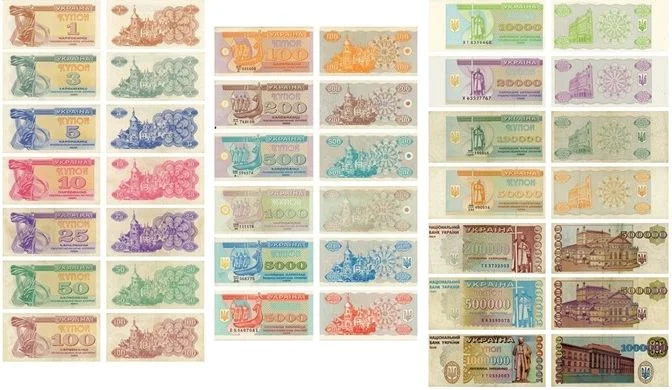
Following the declaration of independence in 1991, Ukraine continued to use the Soviet ruble for a period of time. However, rubles were in short supply as the Central Bank of Russia simply stopped supplying physical cash. To prevent an economic standstill, temporary currency — coupon-karbovanets — was introduced into circulation on January 10, 1992.
Initially, one coupon was worth 1.45 Soviet rubles and even strengthened slightly. But this was short-lived. On November 12, 1992, by decree of President Leonid Kravchuk, the ruble was definitively withdrawn from circulation, making the karbovanets the sole legal tender in Ukraine.
The Era of Hyperinflation: How the Coupon-Karbovanets Saved the Economy
The karbovanets was originally intended as a temporary solution — "for a few months" until a proper currency could be prepared. However, this temporary money endured for four years, navigating one of the most severe waves of price inflation in European history:
| Year | Annual Price Increase |
| 1993 | 102-fold increase (10,156% inflation) |
| 1994 | 5-fold increase (401% inflation) |
| 1995 | Nearly 3-fold increase (182% inflation) |
Simply put: something that cost 100 karbovanets at the start of 1993 cost over 10,000 karbovanets by the end of that same year. At the end of 1992, the largest denomination was the 1,000-karbovanets banknote; by May 1993, 100,000-karbovanets notes appeared, and in 1994–1995, denominations of 100,000, 200,000, 500,000, and 1,000,000 karbovanets entered daily circulation (eventually reaching up to 1,000,000,000 in non-cash transactions) — an era when every Ukrainian unexpectedly became a millionaire.
Uncontrolled currency printing to cover budget deficits and subsidize unprofitable state enterprises caused the karbovanets to rapidly lose value virtually week by week.
How and Where the First Hryvnias Were Printed
Few realize that preparation for the hryvnia began long before its formal introduction. As early as 1992, when the karbovanets had just appeared, the first banknotes designed by Ukrainian artists Vasyl Lopata and Borys Maksymov were printed abroad — in Canada and the United Kingdom. A portion of the initial coins was also minted outside Ukraine, as the country lacked its own mint at the time.
Gradually, the situation transformed:
- In 1994, the Banknote Factory began operations in Kyiv;
- In October 1996, the Banknote Paper Mill opened in Malyn, Zhytomyr Oblast;
- In 1998, the Mint was officially opened in Kyiv.
From that point onward, Ukraine possessed its own complete domestic infrastructure for producing its national currency.
The 1996 Reform: Two Weeks That Transformed the Currency
On August 25, 1996, President Leonid Kuchma signed the decree "On Monetary Reform in Ukraine." The reform itself was executed swiftly and smoothly — from September 2 to September 16, 1996, lasting just two weeks.
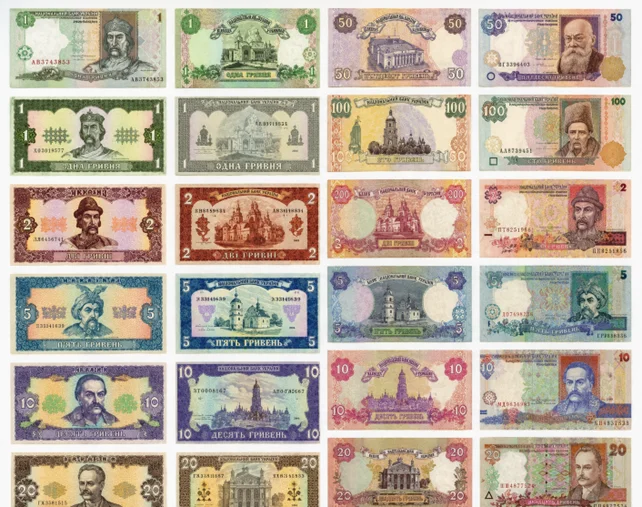
Ukrainians exchanged their old karbovanets for new hryvnias at a rate of 100,000 karbovanets to 1 hryvnia. The exchange occurred without confiscations or restrictions — everything was converted: wages, pensions, bank deposits, and retail prices.
Banknotes in denominations of 1, 2, 5, 10, 20, 50, and 100 hryvnias were released into circulation, along with small change coins (kopiykas) in denominations of 1, 2, 5, 10, 25, and 50. The initial official exchange rate for the newly introduced hryvnia stood at approximately 1.76–1.86 UAH per US dollar.
Shah or Kopiyka: Choosing the Coin's Name
While selecting the name "hryvnia" for Ukraine's national currency met no opposition, naming the hundredth fraction of the banknote sparked lively debate.
Names such as soty, rezana, bofon, cent, kuna, hrosh, and shah were considered. Indeed, shahy were originally intended to enter circulation alongside the hryvnia. In the spring of 1992, designs for change coins — 1, 5, 10, and 25 shahs — arrived in Luhansk from Kyiv, and an initial test batch was struck at the Luhansk Machine-Tool Plant.
However, the communist lobby insisted on the name kopiyka, which had been used in the USSR, the Russian Empire, and Tsardom of Muscovy. On March 2, 1992, a Resolution of the Presidium of the Verkhovna Rada of Ukraine officially approved the name "kopiyka," replacing "shah" on the previously prepared designs.
The first mass-produced kopiykas were minted at the Luhansk Machine-Tool Plant and partially at the Italian Mint, covering denominations of 1, 2, 5, 10, 25, and 50 kopiykas.
The Hryvnia in the 21st Century: Trials, Protection, and the Digital Era
Through Crises and the Trials of War
The hryvnia emerged as a symbol of stability, but its journey was far from easy. Over nearly 30 years, it has weathered several major shocks:
- 1998 — The financial crisis in Russia immediately impacted Ukraine, driving the exchange rate from 1.8 to over 3.4 UAH per dollar.
- 2008–2009 — The global financial crisis saw the rate rise from roughly 5 to 8 UAH per dollar.
- 2014–2015 — The Revolution of Dignity, the annexation of Crimea, and the war in Donbas. During this period, the National Bank abandoned a fixed exchange rate in favor of a floating rate system, which remains in place today.
- 2022 — The full-scale invasion. The National Bank initially pegged the exchange rate temporarily to preserve stability during the critical first months of the war, later transitioning back toward flexible management.
Evolution of Physical Banknote Security
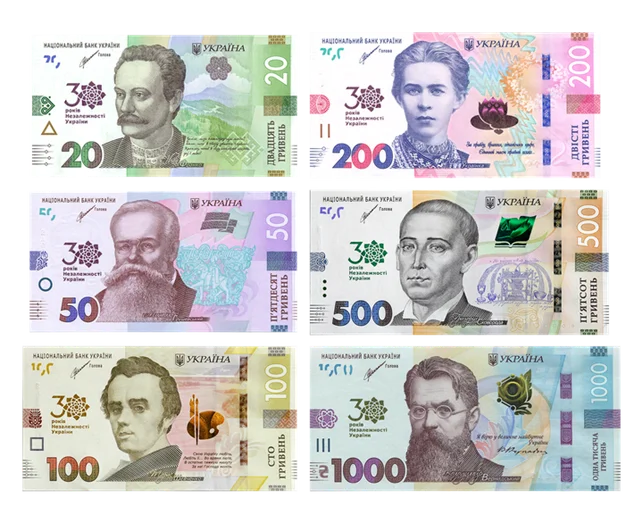
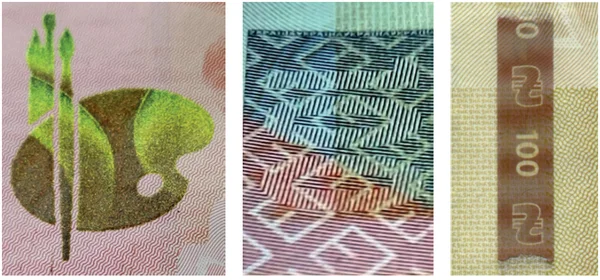
Alongside economic crises, the physical security features of the hryvnia evolved significantly. The first generation of banknotes in 1996 featured relatively simple security elements for their time — primarily Trident watermarks. Part of the second generation was printed by the British company De La Rue, while the remainder was produced by the NBU's Banknote and Mint Centre, which gradually assumed full responsibility for national currency production starting in the mid-1990s.
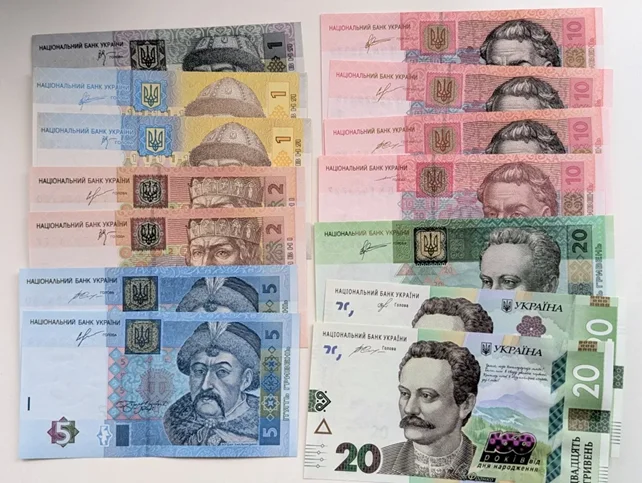
Between 2003 and 2007, the third generation of banknotes entered circulation — smaller in size and equipped with enhanced security features. Between 2014 and 2019, the fourth generation was introduced, featuring windowed security threads and SPARK elements that shift color and pattern depending on the viewing angle. Today, every modern hryvnia banknote integrates over 20 distinct security features. In 2024, amid the ongoing full-scale war, the National Bank began introducing modified banknotes inscribed with the national slogan "Glory to Ukraine! Glory to the Heroes!".
From Paper Coupons to the e-Hryvnia
In tandem with advancing physical banknotes, Ukraine achieved a massive digital transformation. From the flimsy paper coupons of the 1990s, the nation emerged as a global leader in cashless transactions and the adoption of digital wallets such as Apple Pay and Google Pay. Today, the National Bank of Ukraine is developing the "e-hryvnia" project — a digital form of the national currency designed to mark the next evolutionary stage of Ukrainian money.
The evolution of Ukrainian currency throughout the 20th and 21st centuries mirrors the state's own struggle for sovereignty. From Narbut's first karbovanets notes and Khasevych's insurgent bofons to the 1990s coupons and today's high-tech hryvnia, Ukrainian money has consistently asserted the country's right to shape its own destiny. Enduring crises, inflation, and war, the hryvnia has proven its resilience, remaining an enduring symbol of Ukrainian independence.