



Contents of the article
- Why do Ukrainians buy foreign currency?
- Rules for buying and selling cash foreign currency
- How many “shades” of the dollar exist and which banknotes are considered valid?
- Which U.S. Dollars are not accepted by exchange offices and banks?
- What should be done with significantly worn or damaged banknotes?
- Practical tips for safe currency exchange
Foreign currency exchange remains one of the most common financial transactions in Ukraine. At the same time, the greatest number of misunderstandings still arise around cash currency: which banknotes are considered valid, which U.S. dollars are not accepted in Ukraine, and in which cases banks or exchange offices may refuse an exchange. In this article, we systematically explain the current rules for foreign currency exchange, relying on legislative requirements and the practices of financial institutions, to help you carry out currency transactions calmly, safely, and without unnecessary risks.
Why do Ukrainians buy foreign currency?
Ukrainians have been buying foreign currency at least since the introduction of the hryvnia in 1996. Under current conditions—during war, inflation, economic uncertainty, and exchange rate fluctuations—interest in currency transactions continues to grow.
Holding part of one’s savings in foreign currency helps people feel more confident and better plan future expenses. Foreign currency is purchased for various reasons: to accumulate funds, protect savings from depreciation, reduce currency risks, diversify finances among different assets, prepare for expenses abroad or foreign currency payments, as well as for placement in deposits.
The most popular and most reliable currencies in Ukraine remain:
- the U.S. dollar — the leading global reserve currency with high liquidity, widely used in international settlements;
- the euro — one of the world’s key reserve currencies and the official monetary unit of many economically developed European countries.
Rules for buying and selling cash foreign currency
Operations with cash and non-cash funds on the foreign exchange market of Ukraine are regulated by:
- the Law of Ukraine “On the National Bank of Ukraine” No. 679-XIV dated 20.05.1999;
- Resolution of the National Bank No. 103 dated 25.09.2018 “On Approval of the Instruction on the Procedure for Organizing Cash Operations by Banks and Conducting Payment Transactions by Payment Service Providers in Ukraine.”
Currency exchange is carried out through Ukrainian banks and exchange offices that hold the appropriate NBU license and are included in the official Register. It is these institutions that operate under unified rules for foreign currency exchange, which, in particular, clearly define which U.S. dollars are no longer accepted and which are subject to exchange without any restrictions. This guarantees the legality of the transaction and the protection of clients’ rights.
At a bank cash desk or an official exchange office, all necessary information must be displayed for clients, in particular:
- the license;
- the order establishing exchange rates;
- the list of cash operations provided by the institution;
- commission fee tariffs;
- contact details for inquiries.
The cash desk area must be organized in such a way that the client has the opportunity to visually control the cash counting process, as well as have access to a banknote counter with a banknote security verification function.
After completing a currency purchase or sale transaction, the client must receive a settlement document confirming the exchange. Upon its availability, the client has the right to request the cancellation of the transaction within 15 minutes after it is carried out.
If the amount of a currency transaction is 400 thousand hryvnias or more, in accordance with financial monitoring requirements, the client must provide an identity document, a taxpayer registration number, as well as information on the source of the funds.
How many “shades” of the dollar exist and which banknotes are considered valid?
The U.S. dollar is the most widespread savings currency in Ukraine, and it is precisely around it that the greatest number of questions arise.
According to NBU Resolution No. 1 dated 02.01.2019, banks and exchange offices accept and issue all authentic U.S. dollar banknotes that remain valid and were issued after 1914, provided that the following requirements for banknotes are met:
- authenticity and absence of signs of counterfeiting;
- absence of significant damage or critical wear.
The year of issue, design, and “shade” of a banknote do not affect its value. All valid U.S. dollars have the same face value and are accepted for exchange on equal terms regardless of design or year of issue.
In everyday communication in Ukraine, unofficial names are often used:
- “blue dollars” — banknotes of an updated design (often with a blue security strip) that began to be issued in the 2000s;
- “white dollars” — banknotes of earlier series with a lighter design.
These names have no official status or legal significance and describe only the external appearance of the banknotes, not their “quality” or validity.
The first U.S. dollar banknotes appeared more than a hundred years ago—in denominations of 5, 10, 20, 50, and 100 dollars. In different periods, banknotes of significantly higher denominations—500, 1,000, 5,000, and 10,000 dollars—were also issued, which were used mainly in interbank settlements. Such rarities have long disappeared from circulation and are kept in private collections; however, the age of a banknote in itself is not grounds for refusing to accept it.
That is why the questions “which dollars are not accepted” or “which old dollars are not accepted” often arise erroneously: the age of a banknote is not a criterion of its validity. Provided that authenticity is confirmed, all necessary security features are present, and compliance with established standards is ensured, U.S. dollar banknotes without significant damage or severe wear are freely exchanged and issued by both banks and non-bank financial institutions in Ukraine, regardless of the date of their issuance.
Which U.S. Dollars are not accepted by exchange offices and banks?
Banks and official currency exchange offices in Ukraine may refuse to exchange currency only in two cases:
Signs of counterfeiting
Banknotes whose authenticity raises doubts are not accepted for exchange or for making payments and are withdrawn from circulation, with the cashier drawing up a report in the prescribed form. A copy of this report is provided to the client.
A suspicious banknote is transferred to the NBU for expert examination. The verification is carried out by a specialized unit of the NBU, and based on its results, two outcomes are possible:
- the banknote is confirmed as genuine — the funds are credited to the client’s account or exchanged for banknotes fit for circulation;
- the banknote is recognized as counterfeit — it is not returned, the information is transferred to law enforcement authorities, and the client receives a certificate with the examination results. Counterfeit banknotes are withdrawn without compensation.
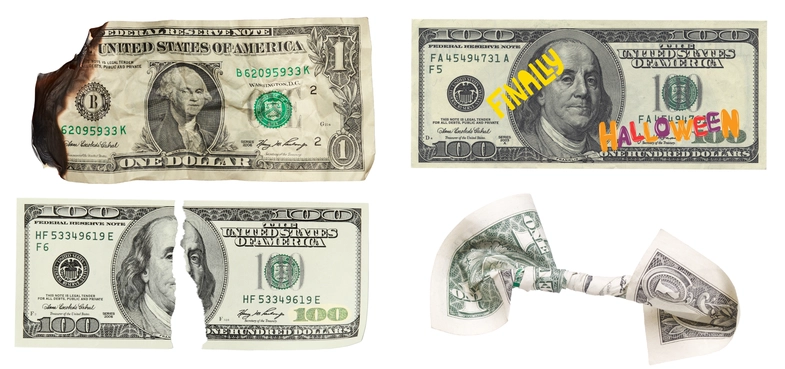
Significant wear or serious damage
Foreign banknotes that have lost their payment suitability due to physical defects or destruction are not accepted for direct exchange. In particular, this applies to banknotes that:
- have tears, cuts, or are divided into parts;
- contain missing or damaged key design and security elements, including denomination markings, portrait images, security threads, or optically variable features;
- have undergone significant changes in the color of the paper or printing;
- have significant localized contamination or stains, including those visible under ultraviolet radiation, if they cover more than half of the banknote’s surface area;
- are characterized by general contamination that causes the paper to glow under ultraviolet light;
- were damaged as a result of exposure to high temperatures, moisture, chemical substances, or show signs of destruction and decay;
- have obvious printing defects.
These criteria determine which U.S. dollars are not accepted by exchange offices and banks. In certain cases, a special collection (collection on an “incasso” basis) procedure may be offered for such banknotes, the terms of which should be clarified with the bank.
U.S. dollars not accepted for direct exchange
What should be done with significantly worn or damaged banknotes?
If a foreign banknote has noticeable signs of physical wear or serious defects—such as tears, heavy contamination, or loss of part of the note—an alternative method of exchange through the incasso procedure may be offered to the client, regardless of the year of issue of such a banknote. Such operations may be carried out exclusively by banks and non-bank financial institutions that are authorized to do so and cooperate with a foreign correspondent bank on the basis of a relevant agreement.
Only certain categories of foreign banknotes are accepted for incasso, namely:
- banknotes that, in the course of circulation, have undergone significant wear or mechanical or other damage;
- banknotes officially withdrawn from circulation by the issuing state after a specified date, provided that the foreign correspondent bank has confirmed its readiness to exchange them.
It should be taken into account that the incasso procedure is time-consuming, and its duration may vary depending on the currency, the degree of damage to the banknotes, and the terms of the foreign correspondent bank. The exact timeframes are recommended to be clarified directly with the financial institution accepting the banknotes.
Banknotes accepted under the incasso procedure are transferred to a foreign correspondent bank for expert examination and subsequent replacement with cash fit for circulation.
Payment for such operations is made in the form of a commission charged by banks in accordance with the requirements of Article 47 of the Law of Ukraine “On Banks and Banking Activity,” based on their own tariffs, which must be openly disclosed to clients.
The timing of crediting the funds is determined by the bank independently and may occur either immediately after acceptance of the banknotes or after receipt of reimbursement from the foreign correspondent bank.
Exchange offices submit such banknotes to Ukrainian banks with which they have concluded relevant agreements.
Practical tips for safe currency exchange
- Clarify the exchange rate before the transaction. Buying and selling rates may differ significantly depending on the institution. Before carrying out the operation, it is advisable to find out the current exchange rates and compare them with the official NBU rate and the offers of different banks.
- Beware of unfavorable locations. Exchange offices at airports, railway stations, and hotels usually set less attractive rates due to their convenient location.
- Always obtain a receipt. The settlement document confirms the fact of the exchange and is necessary in case any questions or disputes arise.
- Choose only official institutions. Use the services of banks or licensed exchange offices to reduce the risk of fraud and to obtain proper consumer rights protection.
- Count the cash at the counter. Check the amount, the condition of the banknotes, and their authenticity immediately during the transaction.
- Take care of personal safety. Do not display cash openly and remain attentive in places with large crowds.
- For significant amounts, choose non-cash exchange via internet banking. This format is more convenient, faster, and safer, especially for large currency transactions.
In summary, it is important to understand that when exchanging both U.S. dollars and euros, the decisive factor is not the year of issue of the banknote but its authenticity and physical condition. Concerns about which dollars are not accepted by Ukrainian banks and exchange offices arise mainly due to widespread myths, whereas in practice all valid and undamaged banknotes are subject to exchange at banks and licensed exchange offices. Compliance with official rules, attentiveness during transactions, and choosing a reliable institution guarantee safe, lawful, and comfortable currency exchange.